A number changes the conversation
Community benefits are common language in major infrastructure development. The phrase can cover jobs, tax revenue, roads, workforce programs, schools, public safety, housing, broadband, parks, water systems, community institutions, and direct financial commitments.
But the term can also become vague. A project can be described as transformative without a clear record of what will actually be delivered, when it will arrive, who will control it, or how anyone will know whether the commitment was fulfilled.
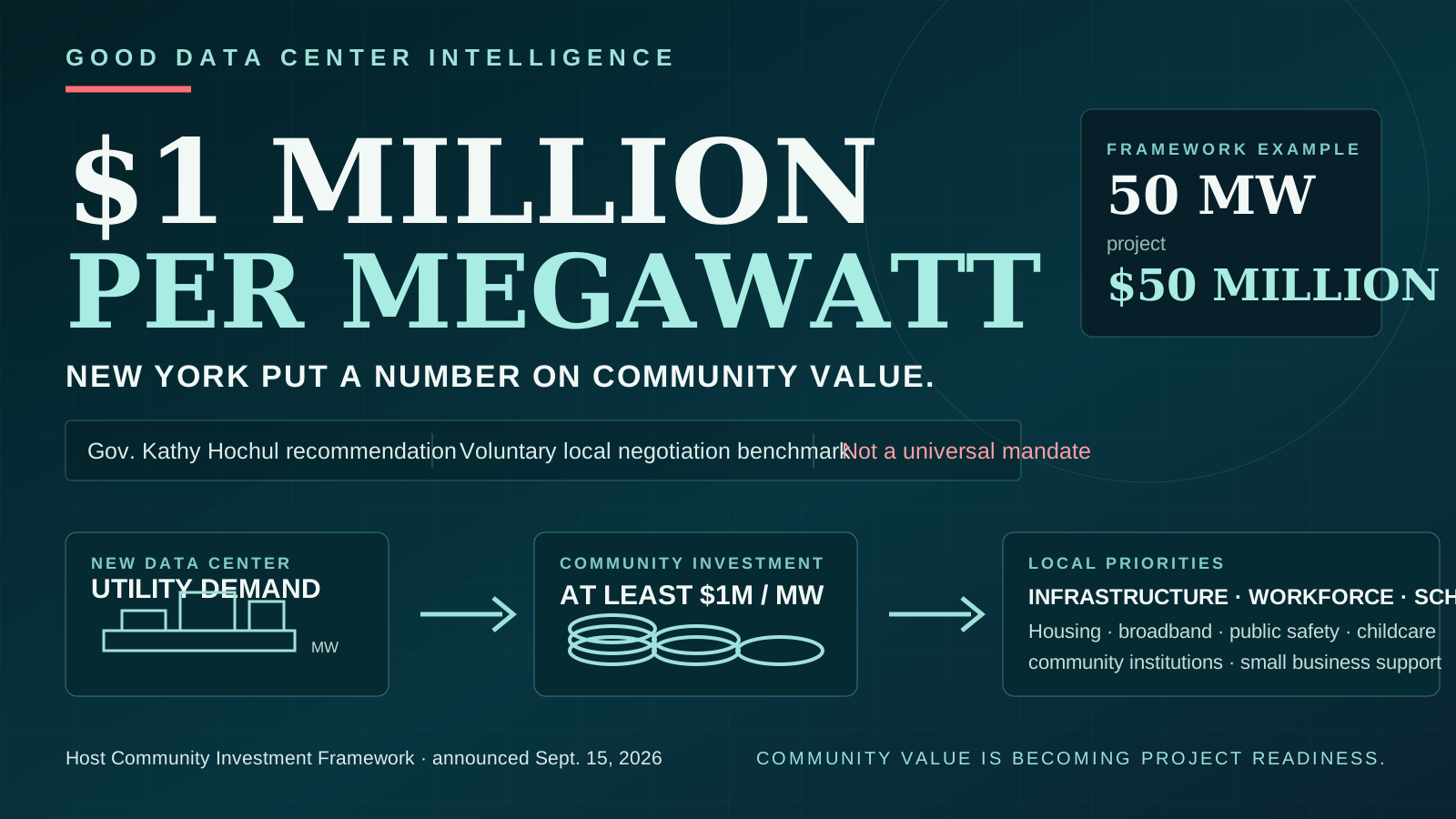
New York's new Host Community Investment Framework for Data Center Development pushes that discussion toward a more explicit starting point. The voluntary framework recommends that local governments begin negotiations at at least $1 million in community investment for every megawatt of utility demand associated with a data center project. Under the state's own example, a 50 MW project would correspond to a recommended $50 million community investment level.
The framework is guidance, not a universal state fee. Local governments and developers would negotiate the amount, timing, form, and administration of investments based on the project and local priorities. New York explicitly describes the framework as a flexible template that communities may modify.
Why New York created the framework
The framework follows Executive Order No. 62, issued in July 2026. The order created a temporary pause on certain state environmental approvals for new hyperscale data center development while New York develops broader standards around power, environmental impacts, ratepayer protection, and host-community benefits.
The order also directed Empire State Development to create a Community Investment Framework that local governments could use when negotiating with data center developers. The September framework is the result.
New York's stated rationale is that data centers can require substantial land, electricity, water, and infrastructure while often producing fewer permanent jobs than traditional large-scale manufacturing projects. The framework therefore asks communities to evaluate a project's demands alongside its expected fiscal and economic benefits, including employment, tax arrangements, infrastructure impacts, and environmental effects.
That distinction matters for economic development. A data center can produce substantial capital investment and tax value without having the same long-term employment profile as a labor-intensive manufacturing facility. A host community therefore needs a broader way to define value.
What can community investment actually fund?
New York's framework gives local governments a wide menu rather than prescribing a single use. Potential investments include:
- roads, water, sewer, energy distribution, parks, and public transit;
- affordable and workforce housing;
- workforce training, apprenticeships, and local hiring initiatives;
- schools, educational programming, and childcare;
- broadband access and public safety;
- community institutions and small-business support; and
- revitalization of vacant or underused property.
The framework also contemplates a locally administered Community Investment Fund and recommends planning for additional commitments when a data center expands or materially increases its infrastructure demands.
This is where the framework becomes more interesting than a headline number.
A $50 million commitment can produce very different outcomes depending on how it is structured. One community may need wastewater capacity. Another may need workforce housing. Another may want road improvements, broadband, fire and emergency capacity, apprenticeship programs, or long-term support for schools.
A useful community-value process therefore begins with the host community's actual constraints and priorities, not with a generic benefits package copied from another market.
Community value should be specific enough to manage
Once community investment becomes part of project readiness, several questions move upstream:
- What investments are directly connected to project impacts?
- What investments represent broader shared value?
- Which commitments are one-time capital investments and which are recurring?
- Who receives and administers the funding?
- What delivery schedule is tied to construction, energization, or operations?
- How do commitments change if the project expands?
- What happens if the project is delayed, downsized, sold, or never reaches full buildout?
Those questions turn a community-benefits conversation into a project-management conversation.
They also protect both sides. Communities gain a clearer record of what has been promised. Developers gain clearer expectations before major capital commitments are locked in.
The framework goes beyond money
The $1 million-per-MW benchmark will attract the most attention, but New York's guidance also addresses operating behavior and public process.
The framework recommends "Good Neighbor" commitments around issues such as water consumption, noise, lighting, building design, and landscaping. It encourages local governments to establish community priorities before negotiations, engage residents and stakeholders early, and clearly assign implementation responsibilities.
It also recommends ongoing reporting once a facility is operating, including metrics such as employment, water and utility use, energy demand, contributions to community-investment funds, and environmental mitigation.
That moves the conversation from what was promised to what was delivered.
Transparency is part of the deal structure
One particularly useful part of the framework is its treatment of confidentiality.
New York advises local governments to consider carefully whether a requested non-disclosure agreement serves the community. If an NDA is used, the state recommends limiting it to legitimate proprietary, commercially sensitive, or trade-secret information that is exempt from disclosure under New York law.
That is a practical distinction.
Major infrastructure negotiations can involve information that legitimately should remain protected. But broad confidentiality can also make it harder for communities to understand the basic terms, impacts, and commitments attached to a project.
A stronger model separates protected information from decision-relevant information that should remain visible.
The $1 million question: benchmark or formula?
The most important caution is that a benchmark should not become a substitute for project analysis.
A 100 MW data center in a water-constrained community with major transmission needs presents a different host-community profile from a 100 MW project on an industrial site with existing infrastructure, reclaimed water, and substantial local tax capacity.
The same dollar figure can therefore represent very different value depending on the local context.
New York's framework accounts for this by keeping the benchmark voluntary and giving localities flexibility. That flexibility is important. The strongest use of a benchmark is as an opening reference point, not as proof that every project has created an appropriate community-value package.
The deeper questions remain:
- What does the project require from the place?
- What value will the project create for the place?
- Which impacts need mitigation?
- Which investments increase local capacity?
- Which commitments remain meaningful over the full project lifecycle?
What this means for developers
For developers, the larger signal is that community value is becoming a pre-development discipline.
Waiting until late-stage public hearings to decide what a host community should receive creates avoidable risk. By that point, land positions may be fixed, infrastructure plans may be advanced, public narratives may have hardened, and political actors may have fewer options.
A stronger development process asks the community-value question early enough that the answer can influence project design, infrastructure partnerships, workforce strategy, operating commitments, and the public process.
That does not mean accepting every request. It means entering a market with a clear view of the project's costs, benefits, constraints, and realistic contribution to the host community.
What this means for local governments
For local governments, the framework raises a different challenge: capacity.
Negotiating with a sophisticated data center developer can require expertise in utilities, fiscal analysis, infrastructure, land use, environmental review, economic development, law, public finance, and community engagement.
A dollar benchmark does not eliminate that complexity.
Local governments still need to understand:
- the project's expected tax contribution and incentive structure;
- power, water, wastewater, road, emergency-response, and other infrastructure requirements;
- the likely timing of construction and operations;
- the project's permanent and temporary employment profile;
- the cost of public services associated with the development;
- the value and feasibility of proposed community investments; and
- the mechanisms that will make commitments durable.
That is why host-community capacity is becoming part of infrastructure readiness.
Good Data Center view
New York's framework reinforces an idea that is becoming more visible across the data center market: community value is becoming part of project readiness.
The strongest projects will increasingly need a clear record that answers four different questions.
1. What does the project require?
Land, power, water, wastewater, roads, public safety, permitting capacity, workforce, and other host systems should be visible early.
2. What does the project create?
Tax revenue, infrastructure, employment, procurement, workforce pathways, strategic capacity, and other benefits should be quantified wherever possible.
3. What needs to be solved?
Material impacts should produce practical responses: design changes, infrastructure funding, mitigation, operating commitments, or community-capacity investments.
4. What will be accountable?
Important commitments should have owners, timelines, evidence, reporting, and a path for dealing with nonperformance or material project change.
That is the difference between a benefits narrative and an accountable community-value case.
The bigger signal
New York's framework is one state's approach, and its $1 million-per-MW figure is a recommendation rather than a national standard.
But the direction is broader.
Canada has established national responsible-development principles focused on community value, ratepayer protection, water, transparency, and strategic value. Other states and local governments are increasingly asking who pays for infrastructure, what host communities receive, what information is available, and how commitments survive approval.
The data center industry is scaling quickly enough that these questions are moving from community-relations work into core project development.
That creates an opportunity.
Better community-value frameworks can give governments stronger decision tools, give developers clearer expectations, and give communities a more concrete understanding of what a project will mean over time.
Questions to carry into projects
- What is the project's complete local value case, beyond the headline capital investment?
- Which community investments address project-created demands and which create broader shared value?
- How should commitments scale if utility demand or project size increases?
- Which commitments should be one-time, recurring, or lifecycle-long?
- Who administers community funds and how are spending decisions made?
- What reporting should remain public after the project is operating?
- How are commitments protected if ownership changes?
- What host-government capacity is needed to negotiate and monitor the agreement?
New York State Host Community Investment Framework
The framework was announced September 15, 2026 following Executive Order No. 62. Good Data Center's development implications and project questions are analysis.
New York Governor's Office · Executive Order framework announcement
Reuters · New York proposes $1 million per megawatt community investment for data centers