The viral version leaves out important context
On October 20, the Utah County Planning Commission voted unanimously to recommend a new data center ordinance for unincorporated parts of the county. After the vote, a confrontation unfolded as sheriff's deputies removed protester Aspen Azalea from the chamber. Video shows Azalea and a deputy going to the floor outside the meeting room.
Azalea has said she suffered a concussion and bruising. The Utah County Sheriff's Office says she struck a deputy in the groin while being removed, says EMS found no immediate emergent injury, and says the incident is under supervisory review. Those are competing accounts of the confrontation; Good Data Center is not attempting to adjudicate them.
There is another important correction to the viral framing: the Planning Commission did not give final approval to the ordinance. Its October 20 vote was a recommendation. The Utah County Commission still makes the final decision.
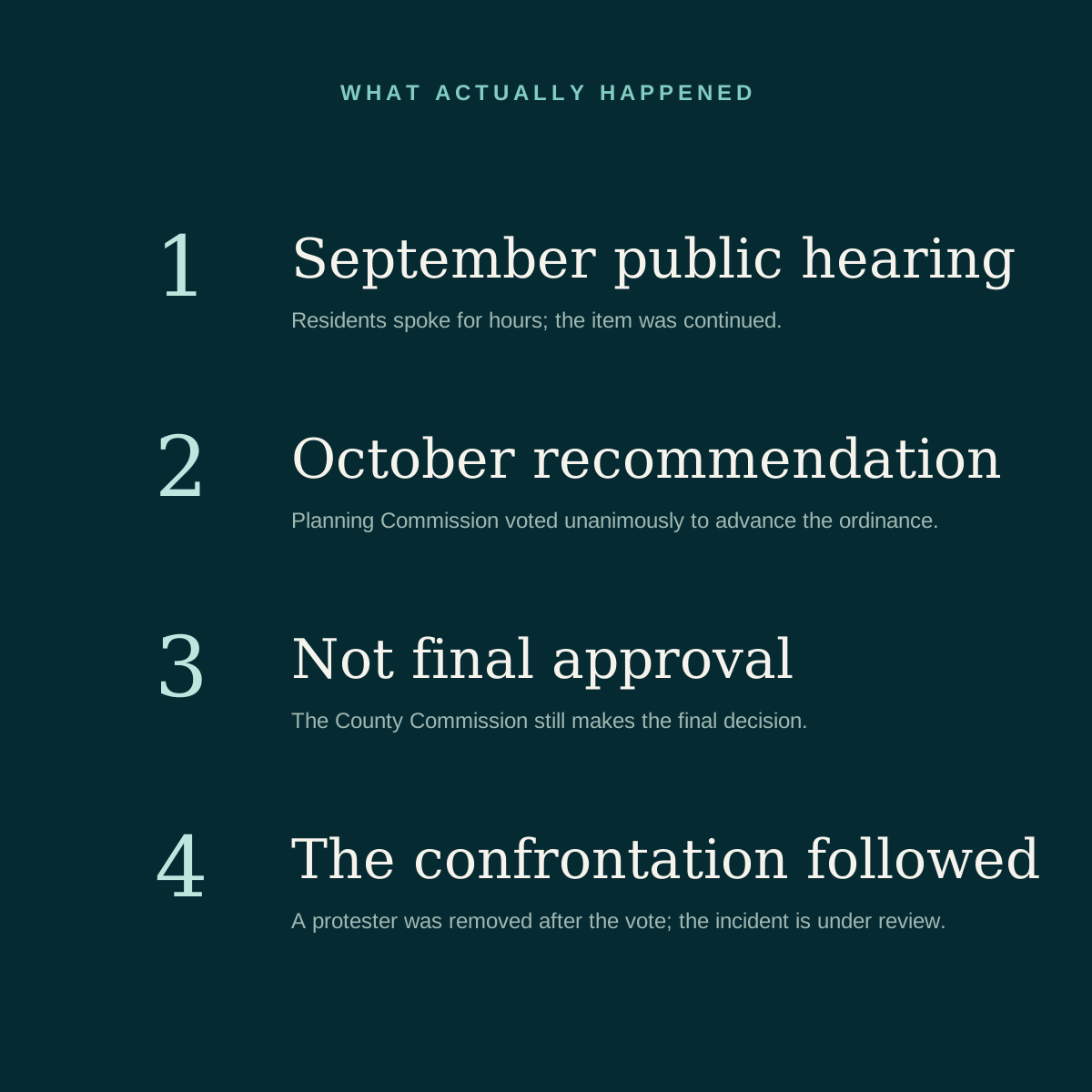
And the October meeting was not the first chance for residents to speak. The Planning Commission held an extensive public hearing on the data center proposal on September 15, heard significant concern about water and other impacts, continued the item, directed staff to revise the draft, and accepted additional written input. The October 20 agenda then listed the continued data-center item under “items not subject to public hearing,” with general public comment scheduled later in the meeting.
The ordinance itself was shaped by public concern
The public process had already changed the substance of the proposed rules.
Between the September and October drafts, the county tightened several provisions. The October proposal includes a fixed 300,000-gallon annual cap for data center cooling-water use, studies of nearby wells and potential water impacts, and monitoring requirements. Reporting from The Salt Lake Tribune says the largest projects would be capped at 500 megawatts and 1 million square feet, with additional siting and notice requirements.
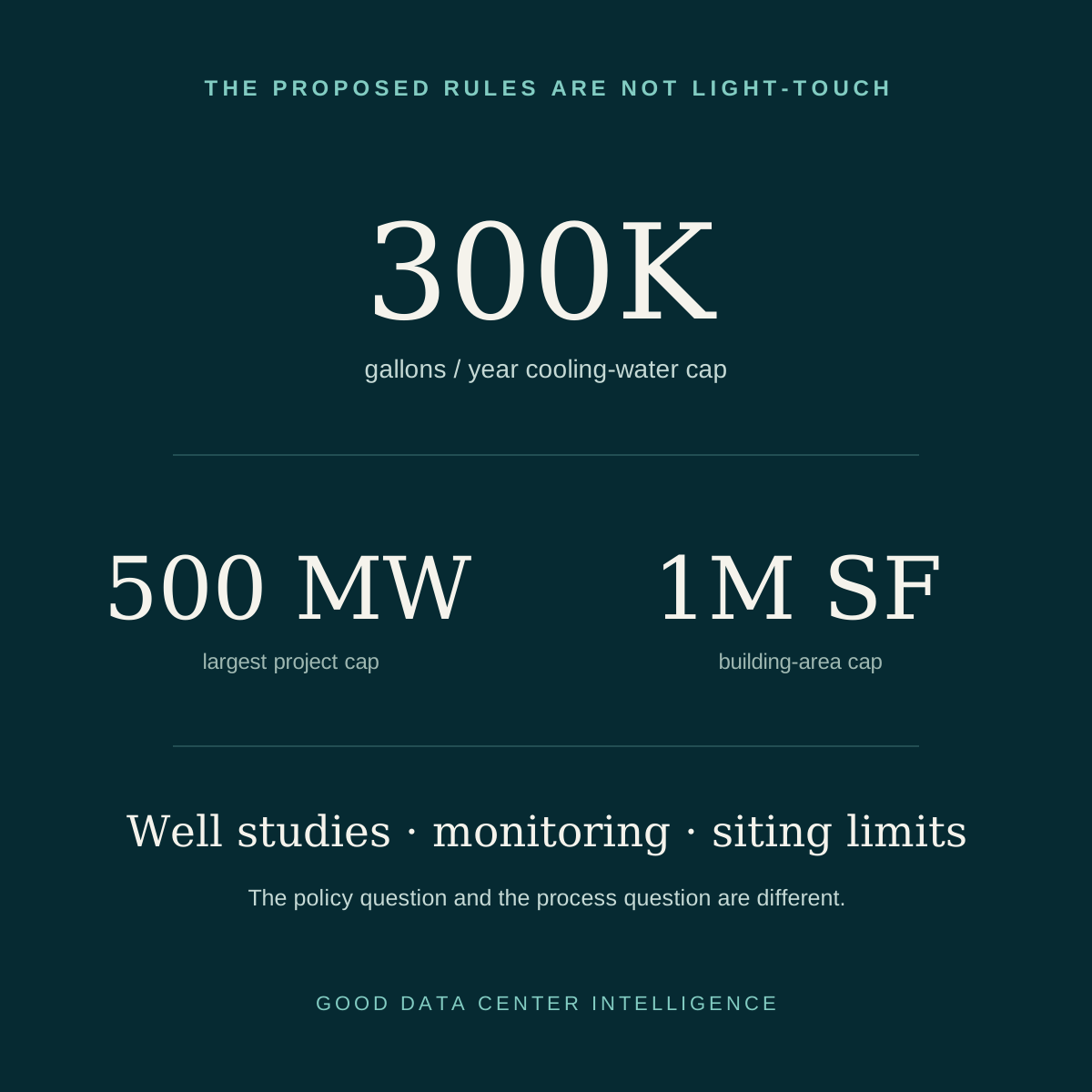
In other words, the policy record is not a simple story of officials ignoring every public concern. Public testimony influenced the draft.
Yet the October meeting still ended with residents feeling shut out and a removal incident becoming the dominant public image of the process.
That is why the process itself deserves analysis.
Why a technically valid process can still fail
Government processes often divide participation into formal windows: a public hearing on one date, written comments by a deadline, deliberation later, a recommendation, and then a final decision by another body.
That can make administrative sense. It also creates a communication problem.
Residents who arrive at the later meeting may experience the process differently. They see officials debating and voting on a major land-use change while the agenda tells them the item is no longer subject to public hearing. If the public-comment period comes after the vote, people may reasonably ask what their comments can still change.
The answer may be that earlier testimony already changed the ordinance and that the final County Commission decision remains ahead. But if that pathway is not visible in the room, the process can feel closed even when it is formally open.
That is a project risk.
Utah had already said public process matters
The tension is especially notable because Utah's statewide policy has explicitly elevated public participation.
In May, Governor Spencer Cox issued Executive Order 2026-03, “Establishing a Higher Bar for Data Center Development in Utah.” Among its principles are protection of water, air quality, wildlife, utility ratepayers, and quality of life—and a requirement for transparent, meaningful, and thorough opportunities for public comment.
The executive order applies to state agencies rather than directly dictating Utah County's meeting procedure, but it reflects the broader standard Utah itself has articulated for data center development.
That makes the Utah County episode useful beyond one meeting.
Public comment is not the same as public influence
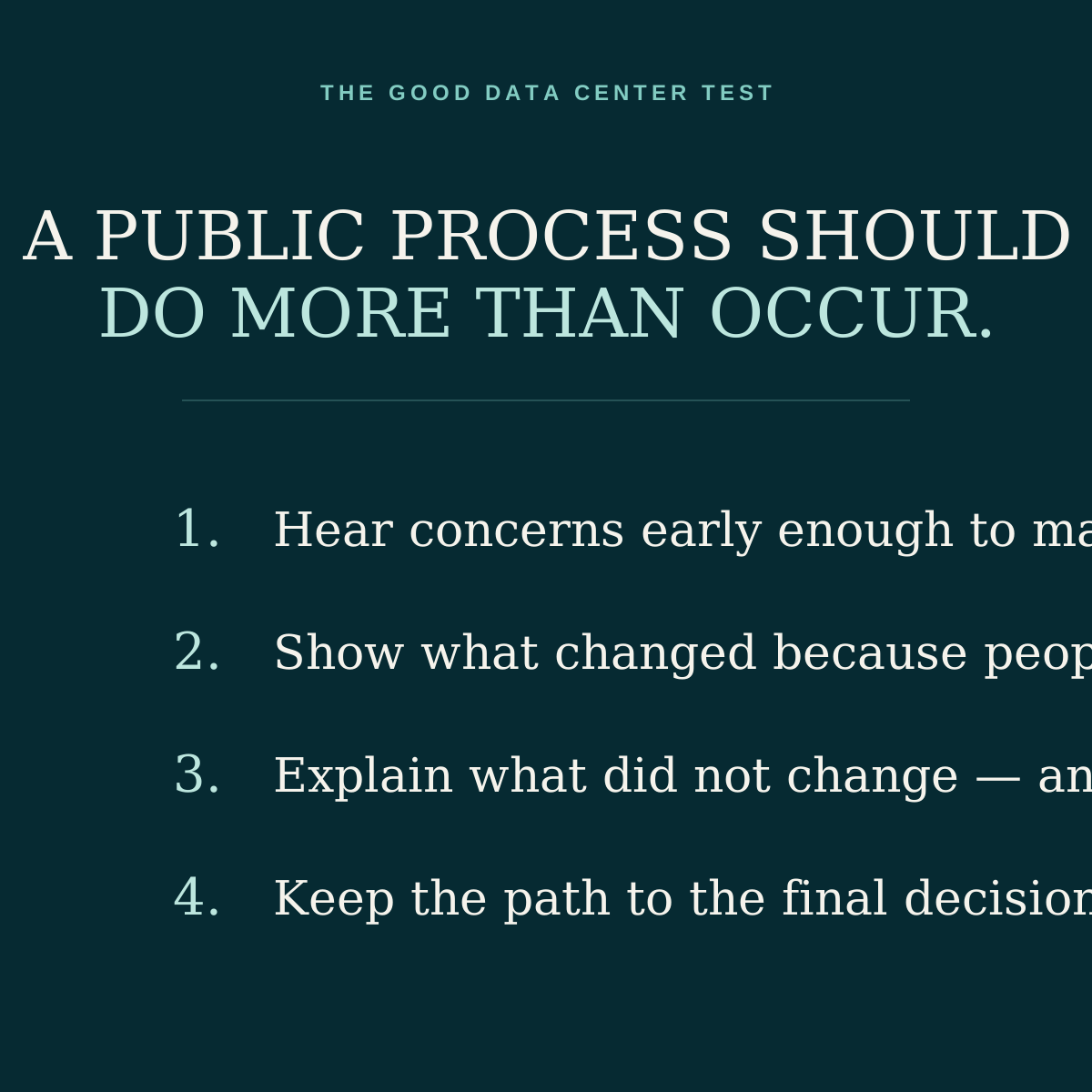
A strong public process should be able to answer a harder question than “Was comment allowed?”
It should be able to show what the public process did.
What concerns were raised?
Which ones changed the draft?
Which ones were rejected?
Why?
What issues remain for the final decision-maker?
Where is the next opportunity to influence the outcome?
Those questions turn public participation from a microphone at the end of an agenda into part of the project decision architecture.
The meeting sequence matters
One lesson from this case is surprisingly operational: agenda design matters.
If a major project or ordinance is controversial, putting general public comment after the vote can create avoidable distrust even if the formal public hearing occurred weeks earlier.
Governments have many options:
- briefly restate the previous public-hearing record before deliberation;
- show which draft provisions changed because of public input;
- clearly explain why the current meeting is or is not another hearing;
- state what the current vote legally does and does not decide;
- identify the next decision point before the vote occurs; and
- provide a short issue-specific comment period when legally and operationally appropriate.
None of those choices guarantee agreement. They can make disagreement easier to navigate because participants understand where they are in the process.
The incident should not erase the underlying policy questions
The confrontation is now the most visible part of the meeting. That is understandable. But it risks swallowing the substantive debate over the ordinance itself.
Utah County is trying to answer real development questions: where data centers should be permitted, how large they may become, how water should be limited and monitored, when nearby wells need study, what notice residents receive, and whether individual projects should require development agreements.
Residents are asking equally real questions about water, quality of life, cumulative development, local control, and whether the rules are strict enough.
A functional public process needs enough legitimacy that those questions—not the meeting breakdown—remain the center of the decision.
Good Data Center view
The lesson is not that every controversial project should be stopped until everyone agrees. Large infrastructure decisions rarely produce unanimity.
The lesson is that public process is itself project infrastructure.
It needs design, sequencing, clear decision points, evidence, ownership, and accountability just like power, water, permitting, or financing.
When it works, people can disagree with the outcome and still understand how the decision was made.
When it fails, the process itself becomes the controversy.
Questions to carry into projects
- Can residents clearly see every decision point before it happens?
- Does the record show what changed because of public input?
- Are comment periods early enough to affect project design?
- Are technical revisions translated into language the public can understand?
- Is the distinction between recommendation and final approval obvious?
- Does the agenda sequence reinforce or undermine trust?
- Can officials explain why major concerns were accepted, modified, or rejected?
- What happens when the meeting process itself becomes the story?
Utah Public Notice Website · October 20 Planning Commission agenda
Utah County Community Development · ordinance materials
Utah County Sheriff's Office · statement on October 20 disturbance
Salt Lake Tribune · meeting, ordinance and confrontation reporting
Utah Executive Order 2026-03 · Higher Bar for Data Center Development